
Last updated October 15, 2026
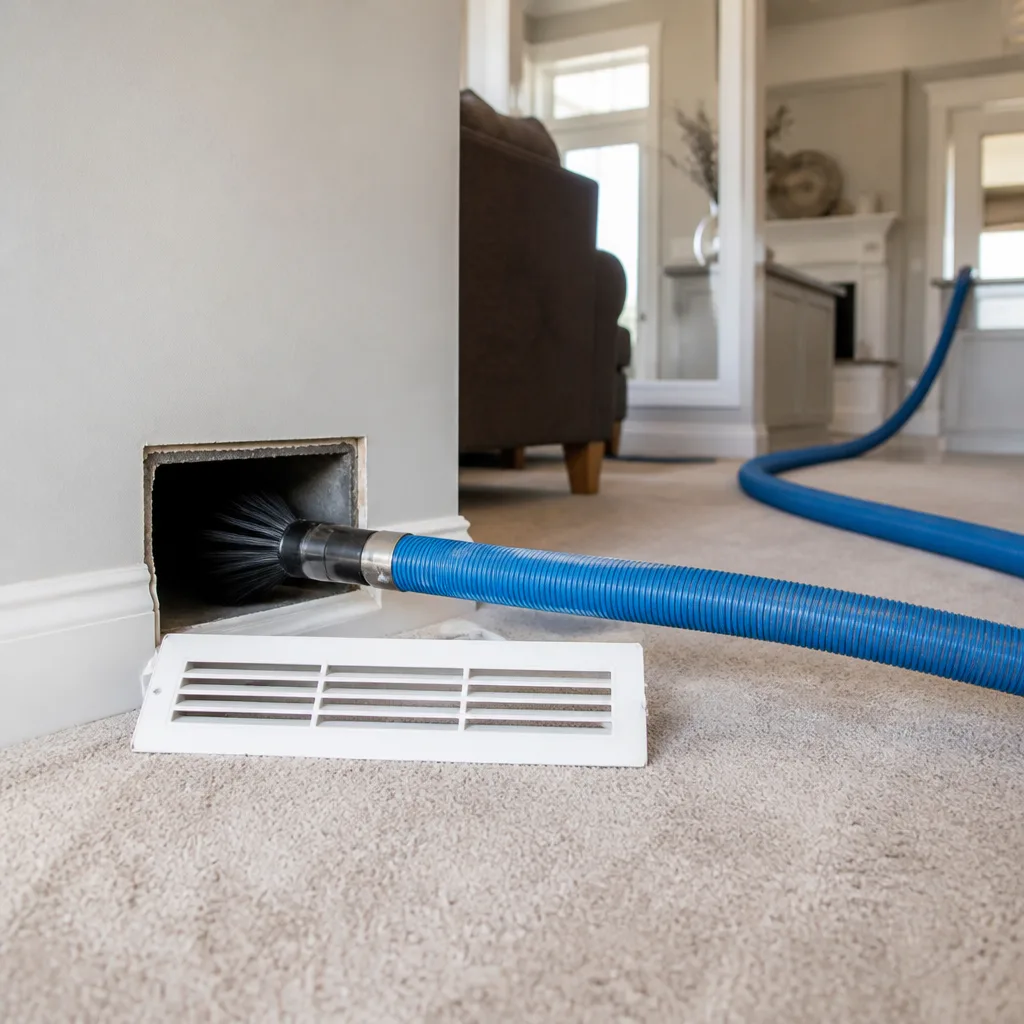 Whole-home duct cleaning
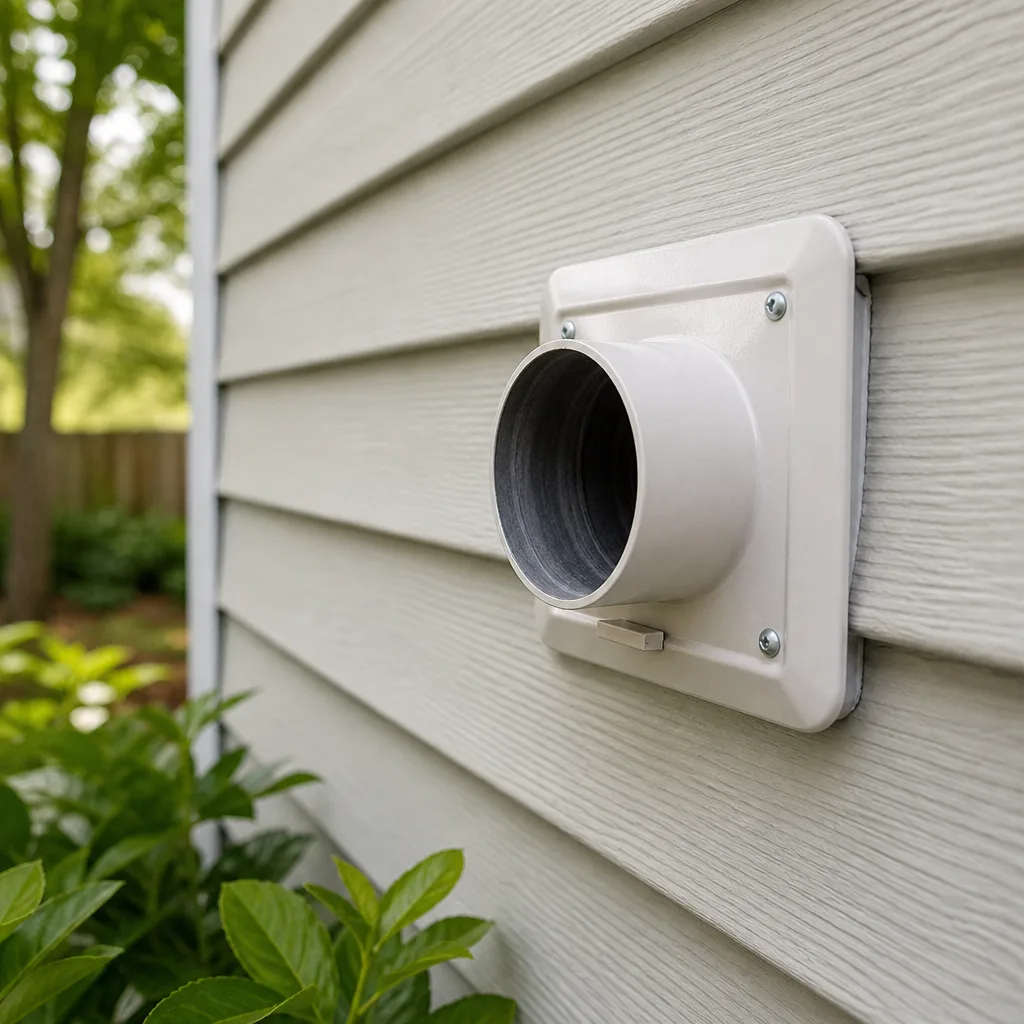 Dryer vent cleaning
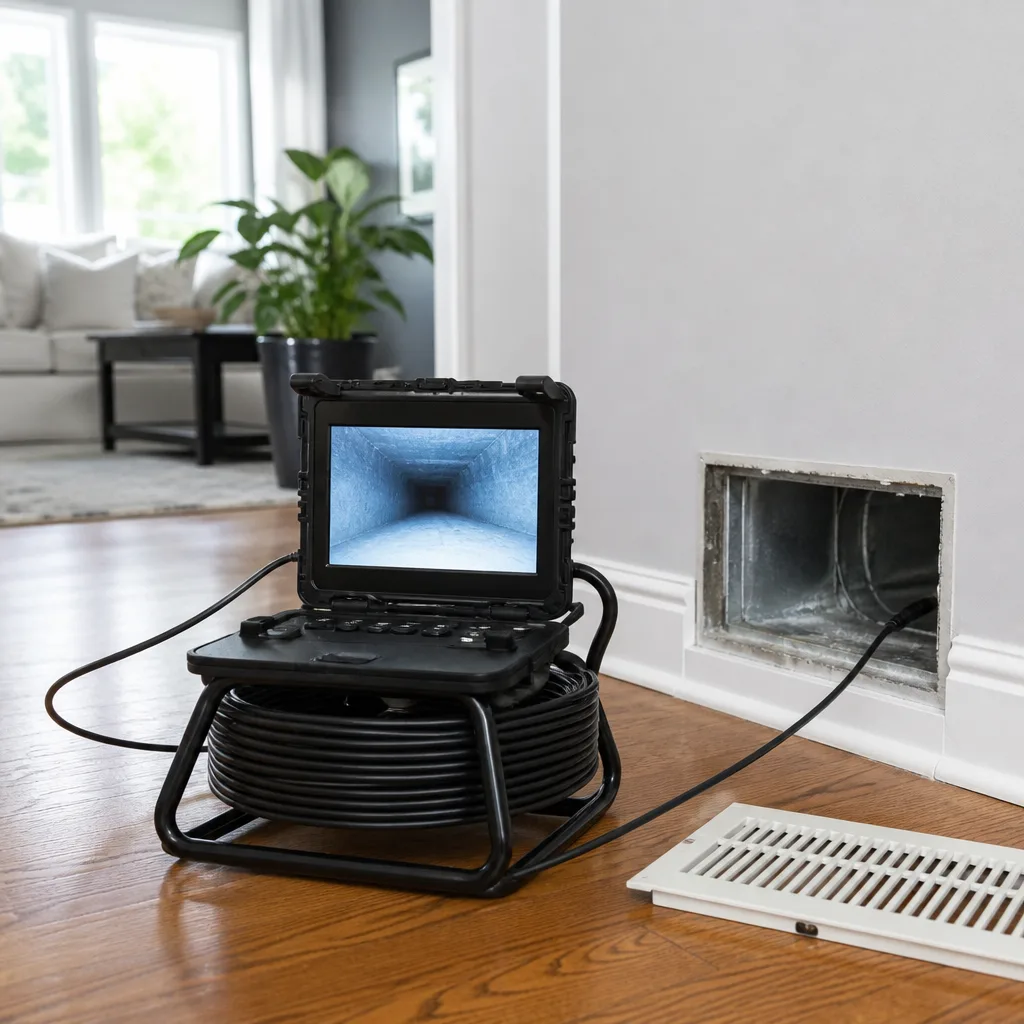 Camera inspection
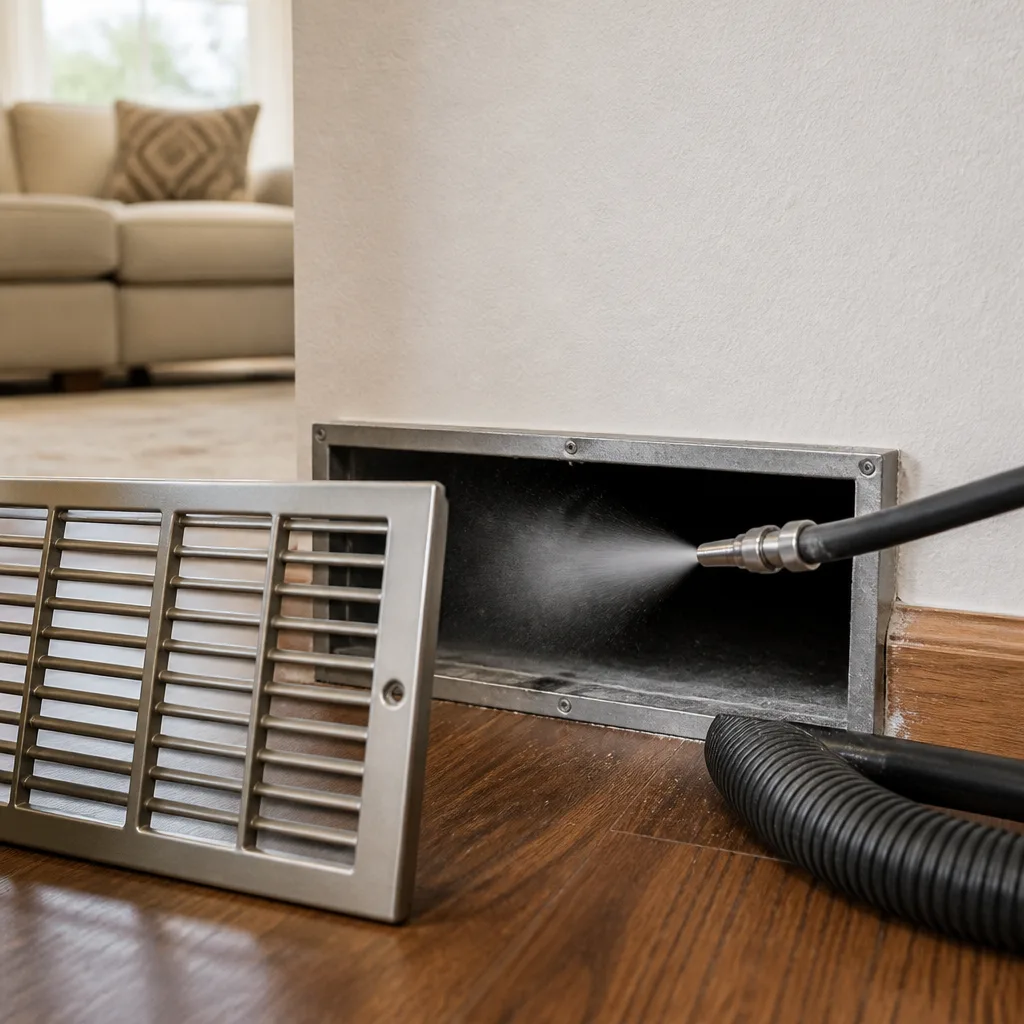 Sanitizing & deodorizing
Whole-system duct and dryer vent check with before-and-after photos - you see exactly what came out of your vents
That "$99 whole-house special" is a bait ad - the real number appears once they are in your hallway, or the "clean" is a shop-vac at the register. We photograph the inside of your ducts before and after instead.
The Complete Guide to Air Duct Cleaning in Houston
Houston HVAC systems run an average of 3,000+ hours per year, nearly double what systems in northern cities log. That means your ducts accumulate debris, moisture, and biological growth on a timeline that national air duct guides simply don’t address. Most of the “how often should I clean my ducts” advice circulating online was written for houses in dry, seasonal climates with basements and shorter cooling seasons. Houston is different. This guide covers what actually builds up in local ducts, what a compliant Air Duct Cleaning looks like under NADCA’s standard, what the work should cost in the Houston market, and how to verify any contractor before they walk through your door.
Styles & brands we work with
Quick Answer
Air duct cleaning in Houston typically costs between $450 and $1,200 for a full single-family home, depending on square footage, the number of HVAC systems, and the condition of the ductwork. A legitimate cleaning follows NADCA’s source-removal method: the entire duct system is placed under negative pressure with a HEPA-filtered vacuum while mechanical brushes dislodge debris from all interior surfaces. In Houston’s humidity, most homes should be evaluated every 2 to 4 years rather than the national 3-to-5-year guideline; see our DIY vs Professional Air Duct Cleaning: The Houston Homeowner’s Decision Guide for help deciding how to proceed.
Table of Contents
- Why Houston Ducts Get Dirtier Faster Than the National Average
- What Actually Builds Up in Houston Ductwork
- Source-Removal Cleaning vs. Contact Vacuuming: Why the Method Matters
- What the NADCA ACR Standard Requires During a Cleaning
- What Air Duct Cleaning Costs in Houston
- What a Legitimate Written Estimate Must Include
- How to Verify a Houston Duct Cleaning Contractor
- How Often Should Houston Homeowners Clean Their Ducts?
- Common Mistakes to Avoid
- When to Call a Professional
- Frequently Asked Questions
- The Bottom Line
Why Houston Ducts Get Dirtier Faster Than the National Average
Three things set Houston apart: subtropical humidity, slab-on-grade construction, and relentless AC runtime. None of these show up in generic duct cleaning advice.
Humidity is the first problem. Houston averages over 50 inches of rain per year and maintains relative humidity above 60% for most of the summer. When humid air moves through a cold duct system, condensation forms inside the ductwork, especially in areas where the ducts run through unconditioned space like attics. That moisture is exactly what mold, mildew, and bacteria need to grow. In drier climates, ducts stay dry enough that microbial growth is rarely a concern. In Houston, it is a routine finding on inspections.
Slab foundations compound the issue. Most Houston homes are built on concrete slabs, which means the supply and return ducts either run through the attic or are embedded in or beneath the slab. Long horizontal duct runs are common, and they collect debris differently than vertical ducts in basement homes. Debris settles along the bottom of horizontal runs and stays there, building up layer after layer. In homes with ductwork in the attic, the temperature swings between the cooled interior and the 130+ degree attic create repeated condensation cycles, which pastes dust and debris onto the duct walls rather than letting it stay loose and easy to remove.
The third factor is runtime. Houston AC systems often run 9 to 10 months out of the year, and during peak summer, a system can cycle on and off every 20 to 30 minutes around the clock. More airflow means more dust, skin cells, pet dander, and debris moving through the system. It also means filters load up faster, and once a filter is saturated, everything it would have caught moves downstream. In our experience serving Houston homes since 2004, we routinely find ducts in this market that look like they have been collecting debris for a decade when they were last cleaned three years ago.
The practical takeaway: if you own a home in Houston and you are following the national “every 3 to 5 years” rule, you are likely waiting too long. Most Houston homes benefit from an evaluation every 2 to 4 years, with actual cleaning scheduled based on what the inspection shows. More on that below.
What Actually Builds Up in Houston Ductwork
Knowing what you are looking at makes you a better buyer. When we open a return plenum in a Houston home that has not been cleaned in years, here is what we typically find:
- Construction debris. Houston has been in a near-constant building boom for two decades. New construction and renovation dust, drywall powder, sawdust, and pieces of construction material routinely end up in ductwork during the build phase and never get removed. In older Houston neighborhoods like Meyerland, Timbergrove, and Oak Forest, renovation debris from remodels is a consistent finding.
- Grey dust and lint. This is the everyday accumulation of dead skin cells, fabric fibers, pet hair, and paper dust. In Houston homes with pets, this layer builds surprisingly fast because the system runs constantly and acts like a whole-house vacuum.
- Biological growth. Houston’s humidity means mold, mildew, and bacterial films are found in local ducts far more often than in dry-climate markets. The growth is typically visible as dark staining or spotting on the interior surfaces of supply runs and plenums. If you smell a musty odor when the system kicks on, this is usually the culprit, not just “dirty ducts.”
- Insect and rodent activity. Houston’s warm climate means pests are active year-round. Cockroach droppings, spider webs, and occasionally rodent nesting material find their way into ductwork, particularly in slab homes where the ducts sit at ground level.
- Filter bypass debris. Houston systems pull massive volumes of air, and many homes run undersized or low-quality filters. The result is fine particulate matter that blows past the filter and coats the evaporator coil, the blower, and the duct interiors.
The composition of the debris matters because it dictates the cleaning method. Dry, loose dust can be removed with aggressive air washing and brushing. Wet, caked-on material, or debris that has been repeatedly moistened by condensation, requires mechanical agitation. Biological growth may require treatment, not just removal. A contractor who asks what you are seeing, smelling, and experiencing before quoting a price is doing it right. A contractor who quotes a flat price over the phone without asking a single question about your home or system is guessing.
Source-Removal Cleaning vs. Contact Vacuuming: Why the Method Matters
This is the single most important technical distinction in the air duct cleaning trade, and most Houston homeowners have never heard it explained in plain terms.
Contact vacuuming is what you get when a contractor runs a large vacuum hose into the trunk line, moves it around a bit, and calls the job done. The vacuum only touches whatever the hose happens to reach. In a Houston slab home with long horizontal duct runs, that means the vacuum reaches the first 8 to 10 feet of each run while the remaining 20 to 40 feet goes untouched. Debris in the far reaches of the run stays exactly where it was. Contact vacuuming is fast, it is cheap, and it does not clean the system.
Source-removal cleaning is the only method recognized by NADCA, the National Air Duct Cleaners Association. Here is how it works in practice:
- The contractor connects a negative-air machine, essentially a large HEPA-filtered vacuum, to the duct system, often at the return plenum or the air handler cabinet. This places the entire system under negative pressure, so any debris loosened inside the system gets pulled toward the vacuum rather than blown into the living space.
- Every register and return opening is sealed except for the one being worked. This directs airflow and ensures the vacuum is pulling air through the specific duct run being cleaned.
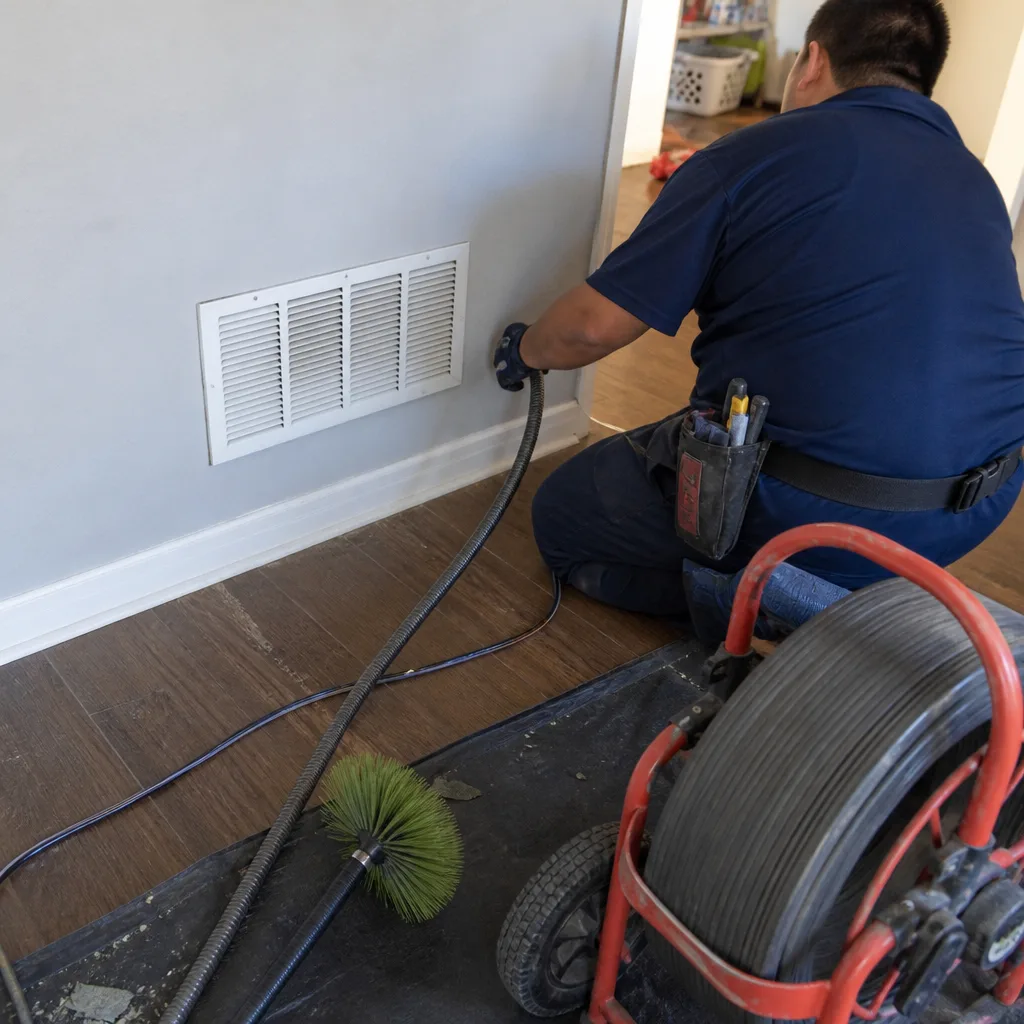
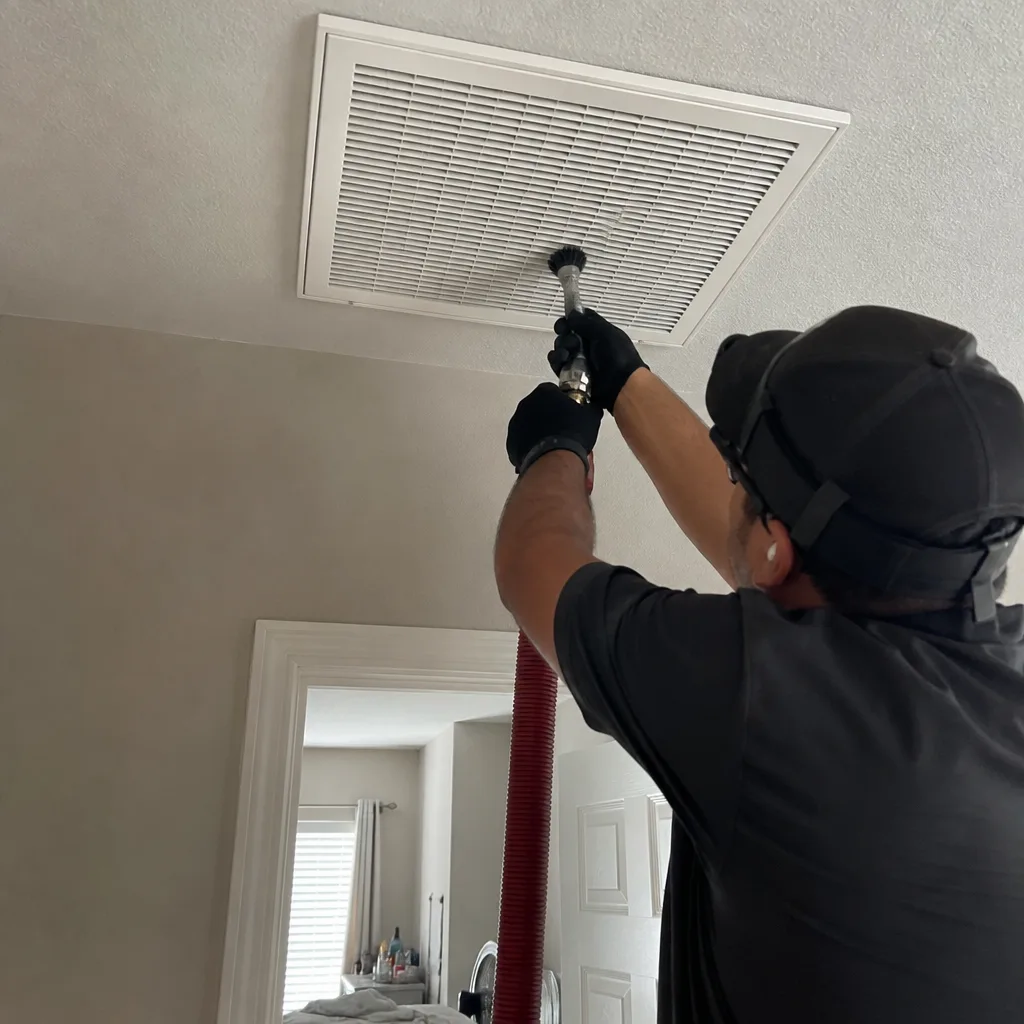
- A rotary brush system or compressed air tools, including the Rotobrush systems we use, are inserted into each duct run. The brush physically agitates the interior surface to break loose debris that has adhered to the duct walls.
- The loosened debris is pulled through the system by the negative air and trapped in the HEPA filter, not released into the house.
- After all duct runs, the trunk lines, the plenums, and the return are cleaned, the contractor cleans the blower, the evaporator coil if accessible, and the air handler cabinet itself. A system is not “cleaned” if the blower and coil are left coated in accumulated debris.
- The technician should then inspect each run, typically with a camera or mirror, to verify the interior surfaces are clean.
This matters in Houston specifically because of the slab construction issue. Horizontal runs that extend 30, 40, or 50 feet from the plenum to a far bedroom register cannot be cleaned by a vacuum hose pushed in from the register opening. They require the full negative-air setup with brush agitation, and they require the technician to open access points at the plenum and at the register to work the entire length. When you are evaluating a Houston duct cleaning quote, ask directly: “Do you use negative-air source removal, and how do you clean the full length of long horizontal runs in slab homes?” A contractor who cannot answer that question clearly is not equipped to clean your home.
For more on how this works on a typical Houston home, see our dedicated page on air duct cleaning in Houston.
What the NADCA ACR Standard Requires During a Cleaning
NADCA’s ACR standard, formally titled the Assessment, Cleaning, and Restoration of HVAC Systems, is the industry’s recognized baseline for what a legitimate duct cleaning must include. The 2021 revision of the standard is the current reference point, and it sets specific requirements that Houston homeowners can use to evaluate any contractor.
Here is what the standard requires, in plain terms, and how to verify each item:
- The entire system must be cleaned. This means the supply ducts, return ducts, trunk lines, plenums, air handler cabinet, blower motor and housing, evaporator coil, and drain pan. If a contractor cleans the ducts but leaves the blower or coil untouched, the job is incomplete by definition. Debris from those components will re-contaminate the ducts within weeks.
- Access points must be opened where needed. The standard requires the contractor to create access openings in the ductwork where the existing openings are insufficient to clean the full length of each run. In Houston slab homes with long runs, this almost always means cutting access holes in the trunk or branch lines. The contractor must seal those access points with proper materials, typically mastic and sheet metal patches, not tape, after cleaning is complete.
- All openings must be sealed during cleaning. Registers and returns not being worked at that moment must be sealed to maintain negative pressure and prevent cross-contamination of the living space. If the crew is working with every register wide open and no negative air machine running, they are not performing source-removal cleaning.
- Visible cleanliness is the acceptance criteria. The standard defines acceptable results as the visible absence of debris on interior surfaces. Ask the technician to show you before and after photos or video of the inside of the ductwork. A legitimate contractor can produce this evidence for every job. We provide before and after documentation on every cleaning we perform because it is the only way for a homeowner to verify the work was actually done.
- Coil cleaning is part of the job, not an upsell. A dirty evaporator coil in a Houston system reduces cooling efficiency, contributes to condensation problems, and rapidly re-contaminates clean ducts. The ACR standard includes coil cleaning as part of a complete system cleaning. Contractors who offer coil cleaning as a separate upsell are not following the standard.
You can verify a contractor’s NADCA membership directly through NADCA’s member directory at nadca.com. Membership is not a guarantee of quality, but it does mean the contractor has committed to the ACR standard in writing, which gives you a documented reference point if the work falls short.
What Air Duct Cleaning Costs in Houston
Honest cost talk matters in this trade. Houston duct cleaning prices have been squeezed downward by aggressive coupon marketing, and we see the results: low teaser prices that balloon at the door, or work done so fast that the system was barely touched. Here are the real numbers for the Houston market.
Typical Houston Price Ranges
- Single system, home up to 2,000 sq ft: $450 to $750
- Single system, home 2,000 to 3,500 sq ft: $600 to $950
- Two systems, home 3,500+ sq ft: $900 to $1,400
- Additional charge per extra access point opened: $45 to $85 per access
- Dryer vent cleaning as an add-on: $75 to $150
- Duct sealing, if needed: $250 to $800 depending on scope
The spread between the low and high ends of these ranges reflects the condition of the system. A lightly soiled system with easy access is a straightforward job. A system with years of heavy buildup, biological growth, or difficult access in a tight Houston attic takes longer and costs more.
Be suspicious of any Houston duct cleaning quote below $300 for a whole home. At that price, the contractor cannot be running a negative-air machine, paying a trained technician, and spending the time required to clean the full length of every run in a slab home. What they are almost certainly doing is contact vacuuming from the register openings, which leaves most of the debris in place and gives you almost no benefit.
Hollis Air Duct Houston writes the price down before any work begins, and that price does not move at the door. No per-vent pricing. No “coupon” that requires a larger scope to actually clean the system. The written estimate includes the full system scope, the number of access points, and the 365-Day Done Right Promise in writing. If it is not done right, we come back and make it right at no charge, within a full year.
Why Some Quotes Are So Much Cheaper
The low-ball quotes exist for one reason: they are a foot in the door, not a price to do the work. The play is familiar. A $49 or $99 “whole house special” gets a crew into your home, and once the technician starts looking at the ducts, the price climbs. Additional access fees, coil cleaning charges, sanitizing add-ons, and per-vent surcharges turn a $99 coupon into a $700 invoice. The technician is under pressure to upsell, and the homeowner is standing in a hot house with a stranger explaining why the advertised price does not apply.
We do not play that game at Hollis Air Duct Houston. The price is written down before we start, and it covers the system as described in the estimate. That is The Garrison Standard, and it is in writing on every job we do.
What a Legitimate Written Estimate Must Include
Before you sign anything or let a crew into your home, the estimate needs to be in writing and it needs to include specific line items; our How to Hire a Air Duct Cleaning Contractor in Houston: A Step-by-Step Guide walks you through exactly what to look for. This is not a nicety. It is the single most effective protection you have against bait-and-switch pricing in the Houston air duct cleaning market.
Here are the items a legitimate written estimate should include:
- The scope of the system being cleaned. The estimate should specify the number of HVAC systems, the approximate square footage, and the general duct layout if known. It should list each component: supply ducts, return ducts, trunk lines, plenums, blower, evaporator coil, drain pan, and air handler cabinet.
- The cleaning method. The estimate should state that the work will be performed using negative-air source removal per NADCA standards. If the method is not stated, assume you are buying contact vacuuming.
- The number of access points included. Houston slab homes frequently require additional access openings. The estimate should state how many are included in the base price and what each additional access costs. If the contractor will not put this in writing, do not hire them.
- Filtration and equipment. The estimate should identify the type of negative air machine and whether it is HEPA-filtered. Professional equipment from manufacturers like Rotobrush, Nikro, Honeywell, and Aprilaire is the standard in the trade. A contractor running a truck-mounted carpet vacuum is not cleaning ducts.
- The guarantee terms. The estimate should state what happens if the work is not done right. At minimum, it should include a written commitment to return and correct any deficiencies at no charge. Our 365-Day Done Right Promise is stated in writing on every estimate: if the work fails within a year, we return and make it right at no charge, including a free second visit.
- The total price, including all fees. No “to be determined” lines. No open-ended labor. The total is the total.
If a contractor will not provide this level of detail in writing before the work starts, you are taking on risk you do not need to take.
How to Verify a Houston Duct Cleaning Contractor
Houston has no shortage of air duct cleaning companies. The barrier to entry in this trade is low: a van, a vacuum, and a website, and someone is in business. Verifying a contractor before scheduling takes 20 minutes and protects you from most of the horror stories in this market.
Here is the verification checklist we recommend:
- Confirm NADCA membership. Go to nadca.com and search the member directory. Membership means the company has committed to the ACR standard in writing. It is not a perfect screen, but it eliminates the majority of low-end operators.
- Verify licensing and insurance. Air duct cleaning is not a licensed trade in the state of Texas, which means there is no state license number to check. That makes insurance verification more important. Ask for a certificate of insurance directly, and call the carrier to confirm the policy is active. Legitimate Houston operators carry general liability coverage and can produce proof on request. If a company will not show you insurance documentation, move on.
- Ask about the equipment. A legitimate Houston duct cleaning crew runs negative-air machines, rotary brush systems, and HEPA filtration. Ask what brand of equipment the crew uses and how they handle long horizontal runs in slab homes. The answer tells you a lot. We use Rotobrush rotary brush systems, Nikro negative-air machines, and filtration products from Honeywell and Aprilaire on our jobs, and we are happy to explain the equipment when a homeowner asks.
- Check for a physical address and a real phone presence. Houston has a persistent problem with out-of-state call centers selling duct cleaning and subcontracting the work to local crews of unknown quality. Call the number on the website. Ask if you are speaking to someone in Houston. Ask for the physical address of the business. If the answers are vague or the call center is clearly not local, the job will likely be subcontracted to the lowest bidder.
- Read the estimate documents. Ask for a sample copy of the written estimate and guarantee language before scheduling. The document itself tells you whether you are dealing with a disciplined operator or a loose operation.
Discipline at the estimate stage carries through to the job itself. A company that writes a clear estimate, stands behind it, and documents the work is the company you want in your home.
How Often Should Houston Homeowners Clean Their Ducts?
The national guidance of every 3 to 5 years is a baseline for average homes in average climates. Houston is not average. Here is a practical schedule for this market:
- Every 2 to 3 years: Homes with pets, homes in neighborhoods with ongoing construction or renovation (think Meyerland, Braeswood Place, Inner Loop rebuilds), homes where anyone has allergies or respiratory conditions, and homes where the AC runs essentially year-round.
- Every 3 to 4 years: Standard Houston single-family homes with average occupancy, no unusual dust sources, and routine filter maintenance.
- Sooner than the schedule: After a home renovation, after a roofing project that sent debris into the attic, after a water leak or flood event anywhere near the ductwork, if you see visible mold growth on registers or smell a musty odor when the system runs, or if you move into a home and do not know when the ducts were last cleaned.
The most reliable signal is a visual inspection. If you can see debris accumulation on the inside of your registers or the return grille, the system needs attention now, regardless of when it was last done. For dryer vent cleaning, which is a fire safety issue, see our page on dryer vent cleaning in Houston for the recommended schedule.
Common Mistakes to Avoid
- Biting on the $49 or $99 whole-house coupon. This is a door-opener offer designed to get a salesperson into your home. The final invoice will be several times the coupon price, or the work will be so superficial that nothing meaningful was cleaned. A legitimate source-removal cleaning in Houston cannot be done profitably for under $300.
- Hiring a company that does not run a negative-air machine. If you do not see a large HEPA-filtered negative-air unit connected to the system, the contractor is not doing source-removal cleaning. You are paying for contact vacuuming, which leaves most of the debris in place.
- Skipping the blower, coil, and air handler. Cleaning the ducts while leaving the blower and coil coated in debris re-contaminates the system within weeks. The entire system must be cleaned, and the estimate should say so.
- Not asking about access points for slab homes. Houston slab construction means long horizontal runs that cannot be cleaned through the register openings alone. If the contractor does not discuss access points, they are likely not planning to clean the full length of each run.
- Accepting a verbal price over the phone. The price does not count until it is in writing. A written price that includes the full scope, access points, and guarantee terms is the standard. Anything less is a risk.
- Hiring without verifying NADCA membership and insurance. Twenty minutes of verification eliminates the bulk of low-quality operators in the Houston market. A company that cannot show proof of standards compliance and insurance does not belong in your attic.
- Assuming the ducts are the only issue. Houston humidity often causes problems in the ducts and at the coil. If the system is sweating, leaking, or showing signs of leakage at the seams, the issue may require duct sealing in Houston in addition to cleaning. A thorough contractor will identify this during the inspection.
When to Call a Professional
Air duct cleaning is not a DIY job, and in Houston it carries risks that dry climates do not. Crawling an attic in July is dangerous work, and improper cleaning can release contaminants into your living space or damage the ductwork. If you see visible debris at the registers, smell a persistent musty odor when the system runs, have not cleaned the ducts since moving in, or have family members with allergies that flare up at home, it is time to have the system evaluated by a professional. Hollis Air Duct Houston offers free estimates in Houston, and you can reach us at (713) 936-5800. Calls are answered by a live person, day or night.
Frequently Asked Questions
Air duct cleaning in Houston typically costs $450 to $1,200 for a full single-family home, depending on square footage, the number of systems, and the condition of the ductwork. A legitimate source-removal cleaning cannot be done profitably for the $99 coupon prices advertised by some operators. Call (713) 936-5800 for an exact written quote.
Low quotes in the Houston market are almost always teaser prices designed to get a technician into your home, after which additional access fees, coil charges, and add-ons push the invoice up. They may also reflect contact vacuuming rather than full source-removal cleaning, which leaves most debris in place. At Hollis, the price is written before any work begins and does not move at the door.
Ask for before and after photos or video of the inside of the ductwork. NADCA’s standard uses visible cleanliness as the acceptance criteria, and a legitimate contractor can document the result after every run is cleaned. We provide this documentation on every cleaning we perform.
In Houston’s humidity and with year-round AC runtime, most homes benefit from evaluation every 2 to 4 years. Homes with pets, recent renovation work, or allergy sufferers in the household may need cleaning every 2 to 3 years. The 3-to-5-year national guideline is often too conservative for this market.
Filter maintenance matters, but it does not eliminate the accumulation of debris, moisture, and biological growth inside Houston ductwork. Filters catch what passes through them; they do nothing for debris that has already settled along the bottom of long horizontal runs in a slab home. A clean system starts with a clean system, not just a clean filter.
You can vacuum the register openings, but that is not duct cleaning. The full-length horizontal runs in most Houston slab homes cannot be reached without negative-air equipment and access openings. Professional equipment, not a shop vac, is required to do the job by NADCA’s standard. Call (713) 936-5800 for a free estimate and an honest assessment of your system.
The Bottom Line
Houston’s combination of humidity, slab construction, and heavy AC runtime means your ducts work harder and accumulate more debris than systems in most of the country. The national 3-to-5-year guidance is not built for this climate. What matters most is that the work is done by source removal, documented in writing, and guaranteed. A written price before any work starts, a full-system scope, and a 365-Day Done Right Promise in writing are the standard by which any Houston contractor should be measured. If your ducts have not been evaluated recently, it is worth the call. Hollis Air Duct Houston serves Houston with written prices, background-checked uniformed technicians, and a guarantee we put in writing on every job. Call (713) 936-5800 for a free estimate.
Written by Roy Castellanos, Owner at Hollis Air Duct Houston, serving Houston since 2004. Browse our more guides & resources for additional HVAC maintenance tips.
See the difference
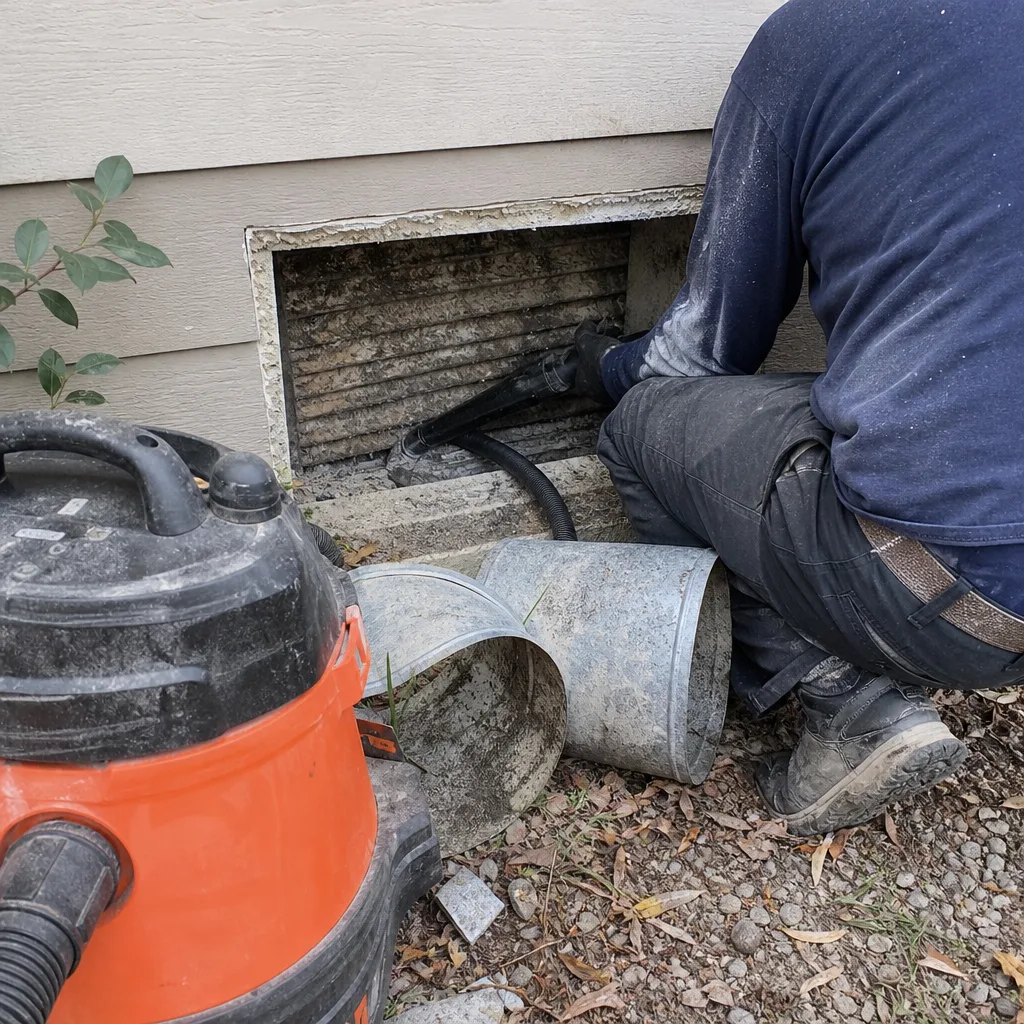 Before
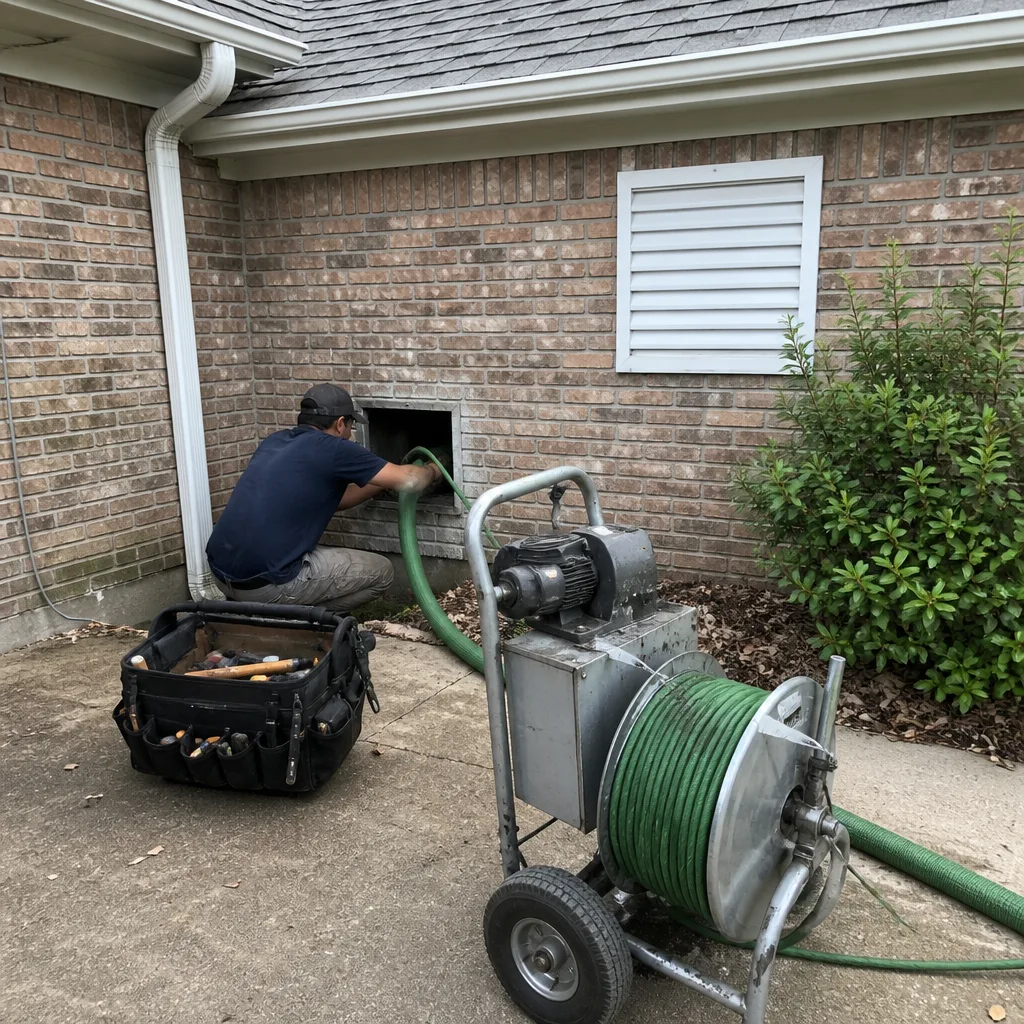 After
After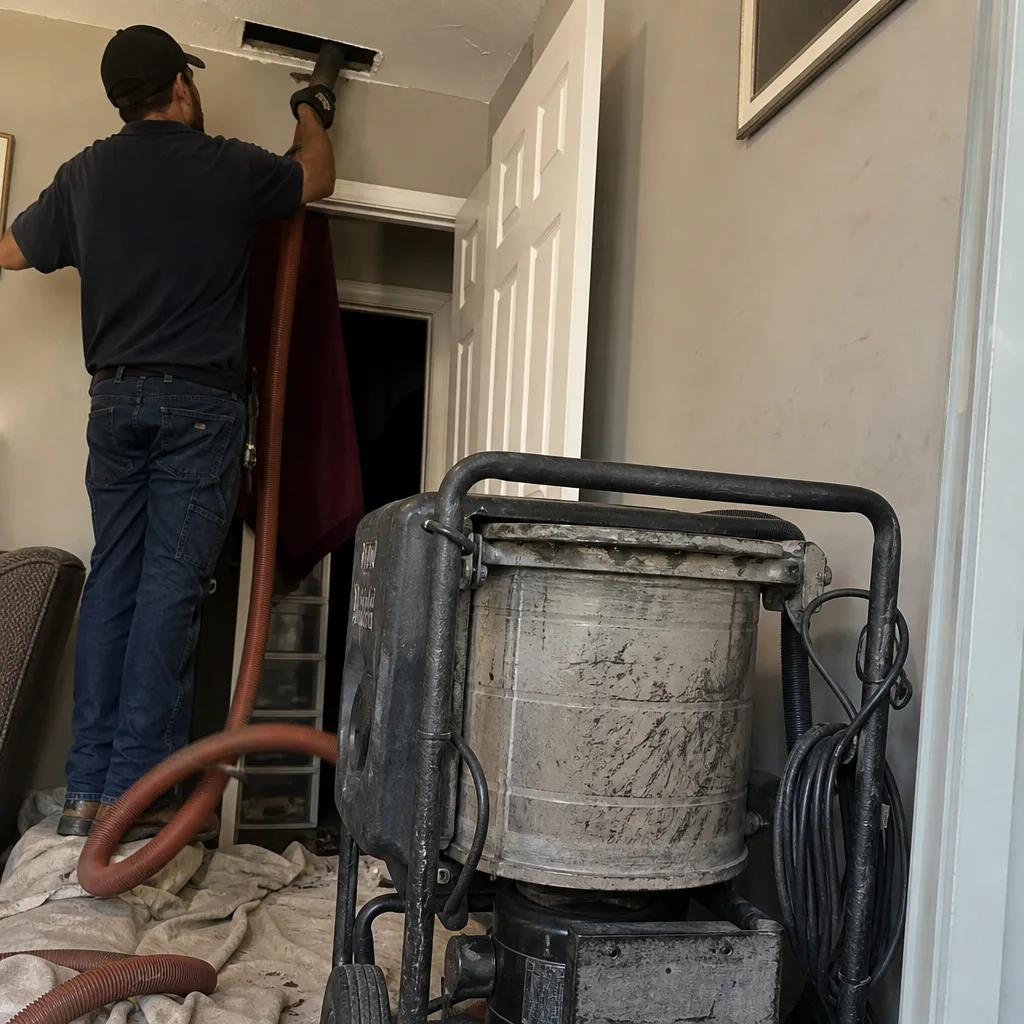 Before
 After
After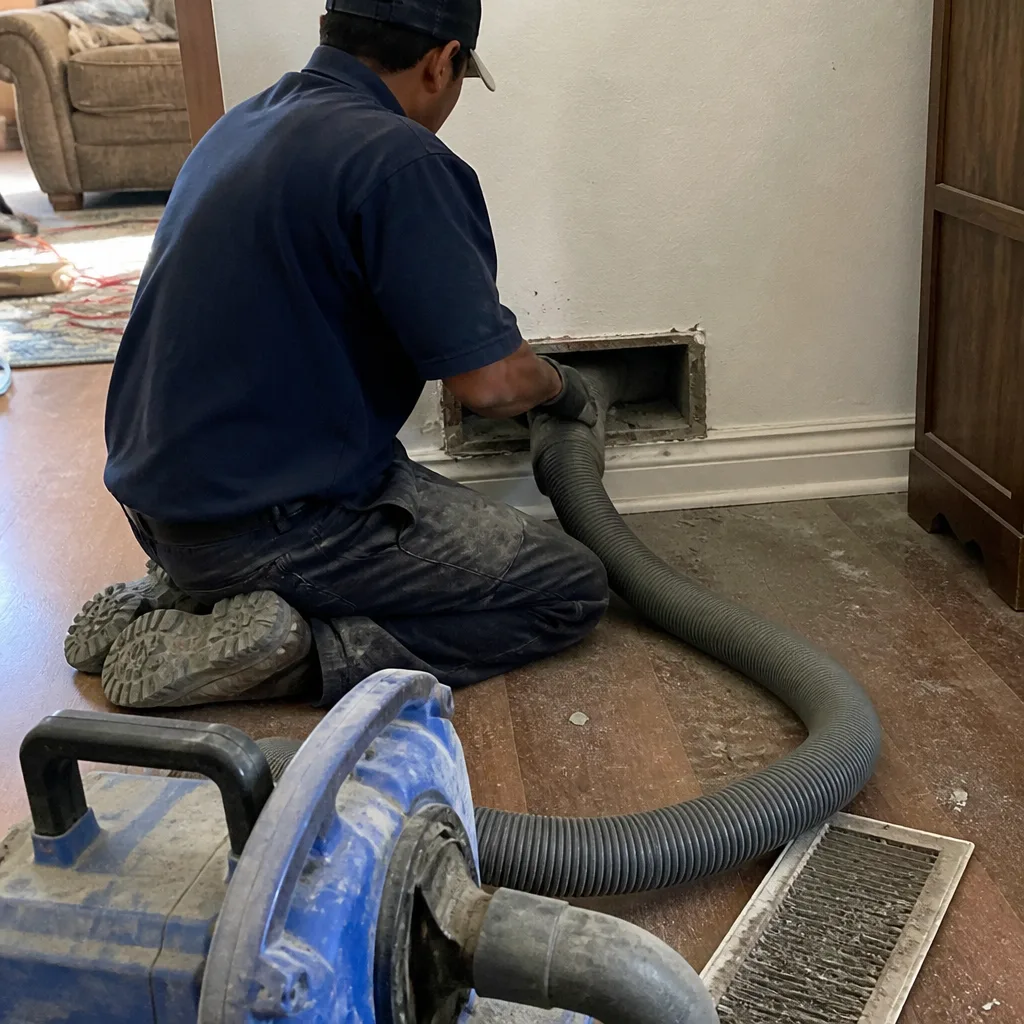 Before
 After
After